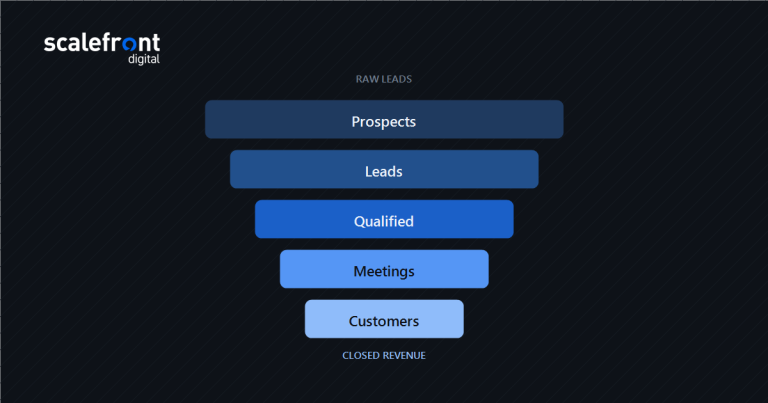
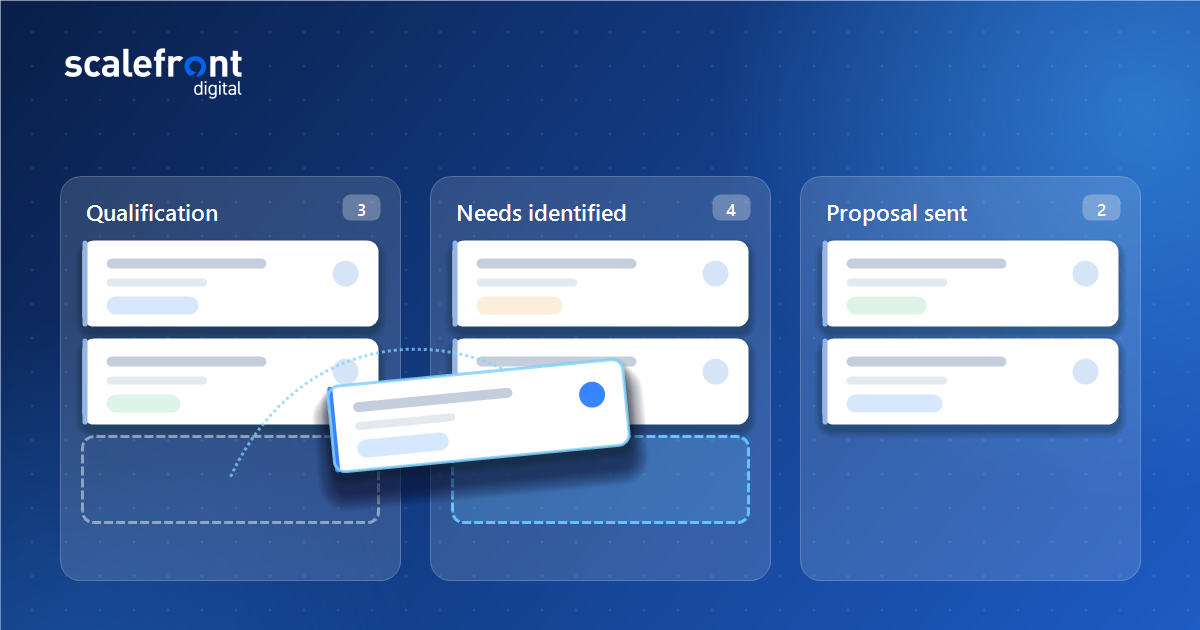
Ask two people on your sales team what has to be true for a deal to sit in “Proposal,” and see whether the answers match. If they do not, your pipeline cannot forecast anything, because the same column means two different things depending on who dragged the card into it.
This is the most common problem in B2B sales operations, and it is rarely a software problem. Companies buy a CRM, create six stages, and assume the pipeline now reflects reality. What they get is a tidy list of open deals, none of which has to prove anything to move forward.
A sales pipeline is only useful when its stages represent real buyer progress. This guide covers what sales pipeline management involves, how to build a pipeline around observable buyer behaviour, and how to run it so the forecast holds.
What is sales pipeline management?
Sales pipeline management is the process of tracking and controlling how deals move through each stage of your sales cycle, from first contact to a closed decision.
In practice it means four things: defining stages that reflect real buyer progress, setting the criteria a deal must meet to enter and leave each stage, removing opportunities that no longer qualify, and measuring conversion between stages to find where revenue is being lost.
It is a management discipline, not a CRM feature. The software draws the columns and stores the records, and CRM and pipeline automation can enforce the rules once you have written them. The definitions behind those columns, and the willingness to apply them when a deal does not qualify, are what make the pipeline predictive rather than decorative.
How a sales pipeline works
A sales pipeline is a stage-by-stage view of every active opportunity, showing where each deal sits between first contact and a closed decision. Each stage represents a step in the buyer’s process, and every opportunity occupies exactly one stage at a time.
It works as a sales forecasting instrument because of a simple relationship. If you know how many opportunities sit in each stage, what they are worth, and how often deals historically advance from one stage to the next, you can estimate what will close and roughly when.
That estimate depends entirely on the stages being honest. If deals move forward without meeting any requirement, historical conversion rates describe nothing repeatable, and the forecast becomes a summary of how optimistic the team feels this quarter.
Sales pipeline vs sales funnel
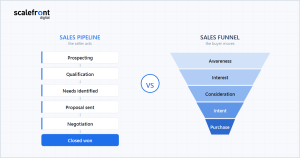
A sales pipeline tracks named opportunities from the seller’s side. A sales funnel tracks volume from the buyer’s side. Both describe the same journey, but they measure different things and you fix them in different ways.
The difference that matters day to day is what each one lets you do about a problem.
| Sales pipeline | Sales funnel | |
|---|---|---|
| Unit | Individual named deals | Populations of people |
| Owner | Sales and revenue operations | Usually marketing |
| Contains | Value, owner, stage, close date | Volumes and conversion ratios |
| You improve it by | Acting on specific deals | Changing targeting, offer, or messaging |
| Answers | “What will close this quarter?” | “Where do people drop out?” |
Why one narrows and the other does not
The shapes are not decorative. A funnel narrows because fewer people continue at each step, so it is measured in percentages and read as a ratio. A pipeline does not narrow, because it lists named deals rather than counting people, and a deal either advances or leaves.
That is also why a pipeline can be honest while a funnel looks healthy, or the reverse. A funnel showing strong top-of-funnel volume tells you nothing about whether those people became deals anyone can close.
Where the two meet
The funnel does not stop and the pipeline start at a clean line, but there is a handoff point, and it is usually the moment a lead is qualified into an opportunity.
Before that point you are managing a population: more traffic, better targeting, a clearer offer. After it you are managing individuals: this deal needs a second stakeholder, that one has gone quiet. The handoff is where most B2B revenue leaks, because the funnel side considers the job done at conversion and the pipeline side inherits a record with no context.
Which one to fix
The practical test is whether a rep could solve the problem by picking up the phone.
If yes, it is a pipeline problem. Deals stalling in one stage, close dates slipping, no next action booked. These are solved deal by deal.
If no, it is a funnel problem. Low conversion from visit to enquiry, the wrong companies filling in the form, an offer nobody responds to. No amount of individual effort fixes those, because the issue is who is arriving, not how they are handled.
Teams get into difficulty when they bring funnel metrics to a meeting that needed deal-level decisions, or when they ask reps to work harder on a problem that was created upstream.
Do you need both?
Yes, and they should share definitions. The most common failure is not the absence of either one, it is that marketing counts a conversion at a point sales does not recognise as an opportunity. When that happens the funnel reports growth while the pipeline reports nothing, and the two teams spend the quarter disagreeing about lead quality.
Why effective pipeline management matters
A large number of open opportunities is not evidence of pipeline health. It is evidence that nothing has been removed.
Consider a B2B software company with a $30,000 average contract value and a 90-day sales cycle. Its CRM shows 120 open opportunities worth $3.6 million against a quarterly target of $900,000. On paper, coverage looks comfortable.
Then apply one test: how many of those 120 have had a meaningful buyer interaction in the last 21 days? If the answer is 45, the real pipeline is $1.35 million, and the other 75 opportunities are inflating the forecast while consuming rep attention.
The inflated version costs you three things: forecasts that miss, which damages credibility and makes hiring decisions unreliable; rep time spent on deals that will never close, the most expensive line item in any sales team; and invisible problems, because a large total hides a broken stage transition that a smaller, honest number would expose.
How to build a B2B sales pipeline
Build the pipeline around how your buyers actually buy, not around how your team hands work over. A pipeline modelled on your own process will show deals advancing while the buyer has not moved at all, which is how a forecast ends up describing your activity instead of their intent.
1. Map the buyer’s decision process
Write down the steps a customer genuinely takes from recognising the problem to signing. For most B2B purchases that includes an internal trigger, an informal search, a shortlist, a business case, a budget conversation, and a procurement or legal step.
Your stages should mirror those steps. If your buyers always need sign-off from a finance stakeholder, that belongs in the pipeline as a visible step, not as something a rep discovers in week ten.
2. Define stages around observable buyer progress
Most B2B pipelines need five or six stages. More than that creates additional places for a deal to sit while looking like progress.
| Stage | What it represents |
|---|---|
| Prospecting | Contact made or inbound lead received, not yet qualified |
| Qualification | Fit, need, timing and authority checked against written criteria |
| Needs identified | The specific problem, its business cost, and the people affected are documented |
| Proposal sent | A written offer with scope and price delivered on a known date |
| Negotiation | The buyer has responded and terms or pricing are being agreed |
| Closed won or closed lost | A decision exists, either way |
“Proposal sent” can be checked. “Interested” cannot, and any stage that cannot be checked will fill with deals nobody wants to close out.
3. Set stage entry and exit criteria
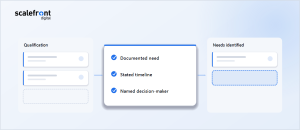
This is the step most teams skip, and the one that converts a list into a forecast.
Entry criteria are the requirements a deal must satisfy before it can enter a stage. They are requirements, not descriptions:
- Qualification requires a documented business need, a stated timeline, and a named decision-maker
- Needs identified requires written notes on the problem and its cost to the business
- Proposal sent requires a proposal actually delivered, with a date
- Negotiation requires the buyer to have responded to that proposal
Exit criteria define how a deal leaves: either it meets the next stage’s entry requirement, or it is disqualified. A third option, sitting indefinitely, is what breaks most pipelines.
Expect the pipeline to shrink when you introduce this, as deals sitting in late stages on optimism fall back to where they belong. That shrinkage is not a loss. It is the first accurate number the team has had.
4. Attach a next action and a time limit to every stage
Every open opportunity should have a scheduled next action with a date. An opportunity with no next action is not in your pipeline in any useful sense, whatever the CRM says.
Each stage also needs a maximum time in stage, set from your own data. If deals typically move from Qualification to Needs Identified within 14 days, a deal sitting there for 40 days is telling you something, and the system should surface it rather than waiting for someone to notice.
5. Connect the five elements
Entry criteria decide what a stage contains. Exit criteria decide how deals leave. The next action makes progress somebody’s responsibility on a date. Time in stage exposes deals that have stalled. Conversion rate then measures whether the stage is working, and because entry criteria were enforced, it measures the same thing every quarter.
Remove one element and the chain breaks. Entry criteria without time limits produce well-qualified deals that stall. Time limits without entry criteria produce fast movement through stages that mean nothing.
How to qualify opportunities
Qualification is the decision about whether an opportunity deserves a place in the pipeline at all. It should happen early, explicitly, and against written criteria that sales and marketing have both agreed.
Four factors carry most of the weight in B2B:
- Fit. Does the account match your ideal customer profile on size, industry, business model and the problem you solve?
- Need. Is there a specific, documented problem, and does the buyer describe it the same way you do?
- Timing. Is there a reason to act within a known window, such as a contract renewal, a compliance date, or a new hire with a mandate?
- Authority. Do you have access to the person who decides, or a credible path to them?
Missing one factor is not automatically fatal. Missing timing and authority together usually is.
Take a realistic case. An operations manager at a 400-person logistics firm requests a demo, describes the problem accurately, and is enthusiastic throughout. There is no renewal date, no budget cycle in play, and she has never mentioned who signs. That deal will sit in Needs Identified for two quarters and close as “no decision.” It is a good conversation and a bad opportunity, and the pipeline should say so on day one.
Opportunities that fail qualification are not wasted. They belong in nurture, where they cost nothing to hold and can return when something changes. What damages the forecast is leaving them in the active pipeline so the total looks healthier than it is.
How to identify and remove stale opportunities
A stale opportunity is one that has had no meaningful buyer activity within the time limit set for its stage. Not no rep activity, no buyer activity. A rep sending a fourth unanswered follow-up is not progress.
Three signals identify them reliably:
- Time in stage exceeds the defined limit with no scheduled next action
- The last substantive interaction was initiated by you, repeatedly
- The close date has been pushed more than twice without a change in circumstances
The third is the most reliable and the most ignored. A deal whose close date has moved from March to June to September has not slipped three times. It was never a Q1 deal, and each revision was a forecast being adjusted to fit a hope.
Run a stale-deal review on a fixed cadence and force a binary outcome on each one: advance it with a concrete next action and a date, or close it out as lost with a reason recorded.
Recording the reason matters more than it seems. After a quarter you will have a list of why deals actually die, which is usually more useful than any win analysis. If a third of your losses are “no decision,” you have a qualification problem, not a competition problem.
How to manage deals through the pipeline
Day-to-day opportunity management comes down to three habits, and all three assume the pipeline already holds the right deals. Our guide to building a B2B lead generation strategy covers that upstream half, because what enters the pipeline sets the ceiling on everything you can do inside it.
Work the stage, not the deal. When a deal stalls, the useful question is what the current stage requires that has not happened, rather than how to push the buyer generally. A deal stuck in Needs Identified usually needs a conversation with someone you have not met, not another follow-up to your existing contact.
Protect the next action. Every opportunity leaves every conversation with a specific agreed next step and a date. “I’ll check in next month” is not a next action. “We’ll reconvene on the 14th with your finance lead to review the numbers” is.
Make disqualification normal. In teams where closing a deal out is treated as failure, reps hold onto dead opportunities and the pipeline inflates. Where it is treated as good hygiene, the forecast stays accurate. This is a management behaviour, not a process one.
How CRM systems support pipeline management
A CRM supports pipeline management by storing every opportunity in one place, enforcing the data requirements attached to each stage, tracking activity and time in stage, and calculating conversion and forecast figures from that record.
It is also what produces pipeline visibility, meaning the ability to answer, without asking anyone, what is in the pipeline, what stage each deal is in, why it is there, what happens next, and when it last moved. Visibility is mostly a by-product of enforcement. If entry criteria are real and the system requires the supporting data, visibility arrives on its own.
The right CRM is the one your reps will actually keep current. A stale CRM is worse than no CRM, because it produces confident forecasts from outdated data. Judge candidates on four capabilities:
- Required and custom fields, so entry criteria are enforced by the system rather than by reminders
- Stage probabilities, so weighted forecasting is possible
- Activity and time-in-stage tracking, so stalled deals surface automatically
- A board or kanban view for fast pipeline review, with one source of truth and no parallel spreadsheets
Salesforce, HubSpot, Pipedrive and Zoho all handle CRM pipeline management competently. The practical differences are setup effort, administrative overhead, and how much configuration your team can maintain without a dedicated operations hire.
What pipeline management tasks can be automated
Automation does not manage a pipeline. It removes the administrative work that stops people from managing it, which is what CRM and pipeline automation is for: making the rules automatic so the process holds without daily supervision.
The tasks worth automating:
- Lead routing to a named owner within minutes of arrival
- Stage gating, where required fields block advancement until they are filled
- Stale-deal alerts when an opportunity exceeds its time-in-stage limit
- Follow-up sequencing triggered by buyer behaviour rather than a rep’s memory
- Data capture from email and calendar into the opportunity record
- Pipeline reporting delivered on a schedule rather than assembled manually
Configuration is where most implementations fail: stages get created, rules never get enforced, routing stays manual, and follow-up depends on someone remembering.
Which sales pipeline metrics matter
Total pipeline value tells you almost nothing on its own. Five measures tell you where the problem is.
| Metric | What it reveals |
|---|---|
| Stage-to-stage conversion rate | Where deals actually drop out |
| Pipeline velocity | How much revenue the pipeline produces per day |
| Average time in stage | Where deals stall |
| Opportunity age | How much of the pipeline is old enough to be unreliable |
| Pipeline coverage | Whether there is enough at the top to hit the target |
How to measure stage-to-stage conversion
Stage-to-stage conversion rate is the percentage of opportunities entering a stage that advance to the next stage. It is the most useful single number in pipeline management, and the reason conversion optimization belongs in sales operations rather than only in marketing.
Stage conversion rate = (opportunities that advanced ÷ opportunities that entered) × 100
Measure it per stage, not just overall. Using the same company: if 80 opportunities entered Qualification last quarter and 32 advanced to Needs Identified, that stage converts at 40%. If Needs Identified to Proposal Sent converts at 75%, your constraint is qualification, and adding prospecting volume will mostly produce more deals that die in the same place.
Always measure on opportunities that entered the stage in a defined period, not on deals currently sitting there, or open deals will distort the figure.
Pipeline velocity
Pipeline velocity measures how quickly your pipeline converts into revenue, expressed as revenue per day. It combines four inputs: the number of qualified opportunities, average deal value, win rate, and sales cycle length.
Its usefulness is diagnostic. Because it has four inputs, it tells you which lever will move revenue most. For some teams that is shortening the cycle, for others it is raising deal value, and the answer is rarely the one people assume.
Opportunity age, win rate and coverage
Opportunity age is how long a deal has been open. Track the distribution, not the average. If a quarter of your pipeline is older than two sales cycles, that portion is not pipeline, it is a list.
Win rate is closed-won divided by all closed opportunities in a period. Calculate it on closed deals only, or the figure becomes meaningless quarter to quarter.
Pipeline coverage is pipeline value divided by revenue target. The right ratio depends on your win rate: a team winning 33% needs roughly 3x, a team winning 20% needs closer to 5x. Calculate yours from your own win rate rather than adopting a number from an article.
How to identify an unhealthy pipeline

An unhealthy pipeline is one whose size does not correspond to its likely revenue. The warning signs are specific:
- A large share of opportunities with no scheduled next action
- Deals clustered in one stage, usually the one before whatever the team finds hardest
- Close dates that move repeatedly without any change in the buyer’s situation
- Conversion rates that swing quarter to quarter, meaning stage definitions are not being applied consistently
- Average opportunity age rising while deal count stays flat, meaning nothing is being closed out
- A forecast that is regularly wrong in the same direction
- “No decision” as the leading loss reason, which points at qualification rather than competition
Any one of these is worth investigating. Three or more together means the pipeline is reporting on itself rather than on the business.
Four causes account for most of it: stages named after internal activity rather than buyer progress, no entry criteria, disqualification treated as failure, and pipeline reviews that end without decisions. Each one is a management choice, not a tooling problem.
Sales pipeline management best practices
- Fewer stages, harder criteria. Six well-defined stages beat ten vague ones.
- Require evidence, not opinion, before a deal advances.
- One named owner and one next action on every open opportunity.
- Set a maximum time in stage and act when it is exceeded.
- Disqualify early and record the reason.
- Review on a fixed cadence and make decisions inside the review, not after it.
Frequently asked questions
What is sales pipeline management?
Sales pipeline management is the process of defining sales stages, enforcing the criteria for moving opportunities between them, removing deals that no longer qualify, and measuring conversion and velocity at each stage. Its purpose is to make the pipeline an accurate forecast rather than a list of open deals.
What are the stages of a sales pipeline?
Most B2B pipelines use prospecting, qualification, needs identified, proposal sent, and negotiation, ending in closed won or closed lost. Names vary between companies. What matters is that each stage has a verifiable entry requirement rather than a subjective description.
How do you manage a sales pipeline?
Enforce stage entry criteria so deals only advance when they meet a defined requirement, give every open opportunity a next action with a date, set a maximum time in stage, disqualify stale deals on a fixed cadence, and measure conversion between stages to find the weakest transition.
What is the difference between a sales pipeline and a sales funnel?
A pipeline tracks named opportunities from the seller’s perspective, each with an owner, a value and a stage. A funnel tracks volume from the buyer’s perspective, from awareness through to purchase. You act on a pipeline one deal at a time and improve a funnel at the population level.
How do you know if your sales pipeline is healthy?
A healthy pipeline has most opportunities carrying a scheduled next action, deals spread across stages rather than clustered in one, close dates that hold, and coverage matched to your actual win rate. Rising opportunity age with flat deal counts is the clearest early warning that it is not.
How often should you review your sales pipeline?
Review it weekly if your sales cycle is measured in weeks, monthly if it runs in months. The review should verify that every deal meets its stage criteria, force a decision on stalled opportunities, and update stage probabilities against what actually closed.