Most B2B companies are not short of leads. They are short of pipeline.
Forms get filled. Lists get built. Sequences go out. The dashboard shows activity. Meanwhile the sales team spends its week chasing people who were curious rather than buying, and the revenue number sits roughly where it did last quarter.
That gap exists because three different things get measured as one. Lead volume counts people who did something. Lead quality judges whether those people match a buyer you can serve. Revenue opportunity is narrower still — a real problem, the authority or influence to act on it, and a reason to act now rather than in eighteen months. A campaign can be excellent at the first and useless at the other two.
A B2B lead generation strategy earns its keep when it produces the third consistently. That requires fewer disconnected tactics and more of a connected system: targeting, intent, data, messaging, outreach, qualification, CRM follow-up, conversion and measurement, each feeding the next. What follows is that system in the order it operates — the same sequence teams at Scalefront Digital work through when a client’s outbound is generating replies but not revenue.
What Makes a B2B Lead Generation Strategy Effective?

The components aren’t exotic. A clear target market and a defined ICP. A working understanding of how the buyer decides. Signals that indicate which accounts are worth prioritizing. Accurate, current contact data. Messaging built around a problem rather than a product. Channels suited to the audience. Qualification criteria sales actually agrees with. Follow-up that doesn’t stop at attempt two. A CRM that reflects reality. Measurement tied to pipeline.
What separates effective programs from busy ones is that these elements are built to depend on each other.
Weak targeting sends good messaging to people who will never buy. Good targeting with stale data means your best-fit accounts never receive the message. Strong outreach with no qualification fills the calendar with meetings that waste a rep’s afternoon. Careful qualification with sloppy CRM follow-up produces qualified leads that go cold in an inbox.
The practical consequence: when lead generation underperforms, the instinct to add volume is usually wrong. Volume amplifies whatever the system already does, failures included. The better question is which link is breaking, because that’s the only place added effort compounds.
Define Your Ideal Customer Profile
Broad targeting feels like a hedge. In practice it produces the worst outcome available: enough responses to keep the program alive, not enough fit to produce revenue, and no clear signal about what to change.
A usable ICP is specific about firmographics — industry and sub-vertical, company size, geography, business model — because those variables change how a company buys. A 40-person agency and a 4,000-person enterprise in the same industry have almost nothing in common procedurally. Beyond that, an ICP should name the operational pain you solve, the triggers that make it urgent, and the roles involved in the decision.
That last point gets less attention than it deserves. In most B2B deals the person who feels the problem, the person who evaluates solutions and the person who signs are three different people. A strategy built around one of them stalls somewhere in the middle.
An ICP describes the account. A buyer persona describes the person inside it — what they own, what they’re measured on, what makes them hesitate. You need both, and they do different jobs: the ICP decides who you contact, the persona decides what you say. A team that has documented how its buyers actually buy — stages, objections, internal approvals — is running a sales motion rather than a list of activities, which is where a managed sales process begins.
Use Buyer Intent to Prioritize Prospects
A well-defined ICP may still contain thousands of accounts. Buyer intent decides which deserve attention this month.
The useful signals are observable. Repeat visits to pricing or solution pages. Job postings that show a team being built around a function. Expansion into a new market. A technology change — adopting a platform yours integrates with, or dropping a competitor. Leadership changes, particularly a new department head, who usually arrives with a mandate and a budget window. Funding events. Research activity on third-party platforms.
Each says roughly the same thing: something inside this account has changed, and change is what creates willingness to evaluate a new vendor. A company with a stable team, stable stack and stable headcount rarely goes looking, however good your message is.
Intent prioritizes; it doesn’t predict. An account showing three strong signals is a better use of your next hour than one showing none — but it may be researching a project that never gets funded, or gathering quotes to renegotiate with an incumbent. Use signals to order the list and shape the opening line, not to skip qualification later. That’s the logic behind structured intent lead research: building the signal stack that surfaces the slice of your market currently in motion.
Build Better B2B Lead Data
A list of 50,000 contacts isn’t an asset. It’s a liability with a monthly bill attached, because every invalid address damages your sending reputation and every mistargeted contact costs a reply you’d otherwise have earned.
Data quality comes down to a few checks. Account fit — does this company match the ICP, or match a keyword in the ICP? Decision-maker mapping — have you identified the right roles, including the influencer who’ll be asked for an opinion before anyone takes a call? Contact accuracy — are addresses verified and titles current? Enrichment — do you have the context that makes a message specific: headcount, stack, structure, recent announcements? Freshness — B2B data decays continuously as people change jobs, so a list built nine months ago is not the list you think it is.
Enrichment has a ceiling worth respecting. Inserting a company name into a template is not personalization; it’s a template with a variable. The enrichment that changes outcomes lets you write one sentence no competitor could have written to that account. That takes fewer accounts and better research — the trade-off behind proper B2B lead list building and enrichment.
Choose the Right Channels and Messaging
Channel selection follows the audience and the buying process, not what’s currently fashionable.
Cold email scales and works when the ICP is tight and the value proposition is legible in three sentences. LinkedIn suits senior roles and longer consideration cycles, where credibility accumulates before a conversation is possible. Organic search captures buyers already problem-aware or solution-aware — slower to build, more efficient once it exists. Referrals convert best and are hardest to scale deliberately. Paid acquisition buys speed and fast testing. Partnerships work when someone else already holds the trust you need. SMS has a narrow but real place, usually confirming or reviving a conversation rather than starting one.
The deciding variables: where your buyers pay attention, how long the cycle runs, how many people are involved, and what the deal size justifies per touch. A six-month, five-stakeholder enterprise cycle and a two-week self-serve purchase don’t deserve the same mix.
Messaging is where most programs quietly fail. The default is to describe the company — what it does, how long it’s done it, which features it has. Buyers don’t open cold messages to learn about vendors. They respond when a message names a problem they recognize, in language they’d use themselves, and makes the next step small. “We help B2B companies scale revenue” says nothing. “Your team posted three SDR roles last month — most companies at that stage find list quality breaks before headcount does” says you were paying attention, and earns the assumption that the rest of the conversation is worth the time.
Build a Multichannel Outreach Process
Email and LinkedIn complement each other when sequenced deliberately and compete for attention when they aren’t. The pattern that works: a profile view or connection establishes familiarity, the email carries the substance, and a LinkedIn message follows days later referencing the same theme without repeating it. The prospect should experience one coherent approach, not two bots working the same target.
Sequencing is mostly about restraint. Space touches over weeks. Vary the angle each time rather than resending the same request with “just following up” on top. Keep the number of attempts finite and defined, so a non-response closes cleanly instead of lingering. Most replies arrive after the first message and before the sequence ends — which means teams that stop at two touches and teams that send fourteen are both leaving results behind, for different reasons.
Consistency is what makes any of it measurable. A campaign that runs three weeks, goes quiet for two months and restarts with new copy will never produce stable data about what works. Reliable sending volume, monitored deliverability and clean domain setup are the unglamorous infrastructure behind email automation that generates predictable numbers.
LinkedIn runs on a different rhythm. Connection limits, profile credibility and reply handling stay manual-feeling even when parts are systematized, and a tone that works in the inbox often reads as too formal in a LinkedIn message. Treating LinkedIn outreach as its own channel, rather than an email sequence pasted into a different window, is usually the difference between a connection accepted and one ignored.
Qualify Leads Before They Enter the Pipeline
A reply is not a lead. A meeting request is not an opportunity. Qualification is what turns interest into something forecastable.
The factors are consistent across most B2B contexts: ICP fit, genuine need rather than curiosity, timing — is there a reason to act this quarter — authority or access to it, budget where deal size makes it relevant, supporting buying signals, and depth of engagement. Not every factor must be present. But a prospect with need and no timing, or authority and no budget, belongs in nurture, not in the pipeline.
The standard progression runs Lead → MQL → SQL → Opportunity. A lead has entered your world. An MQL meets the marketing-side criteria worth a sales look. An SQL has been examined by sales and judged worth pursuing. An opportunity has a defined need, a rough timeline and a path to a decision.
Those definitions are company-specific, and that’s the point — there is no universal MQL. What matters is that marketing and sales agree on the criteria, write them down, and revisit them when conversion rates between stages start drifting. Most arguments about “lead quality” are unresolved disagreements about definitions.
Connect Lead Generation to CRM and Follow-Up

Generating a qualified lead is the start of the work. More pipeline is lost after the reply than before it.
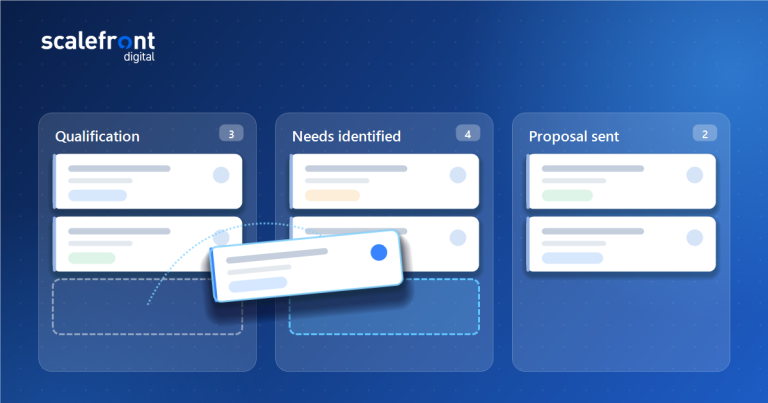
The mechanics matter. Routing rules so every lead lands with a named owner within hours. Unambiguous ownership, because a lead assigned to a team is assigned to nobody. Pipeline stages that reflect what the buyer is doing rather than what your team is doing internally. Activity tracking detailed enough to show when a deal actually went quiet instead of guessing. Meeting booking that removes friction rather than adding a scheduling negotiation.
The marketing-to-sales handoff is the usual failure point. A lead arrives carrying context — the signals that prompted outreach, the messages sent, the questions asked — and that context rarely survives the transfer. The rep opens a cold record, asks what the prospect already answered, and the conversation loses the momentum outreach built. CRM and pipeline automation is largely about making the context travel with the lead and the follow-up happen on schedule without anyone having to remember.
Optimize the Path From Lead to Customer
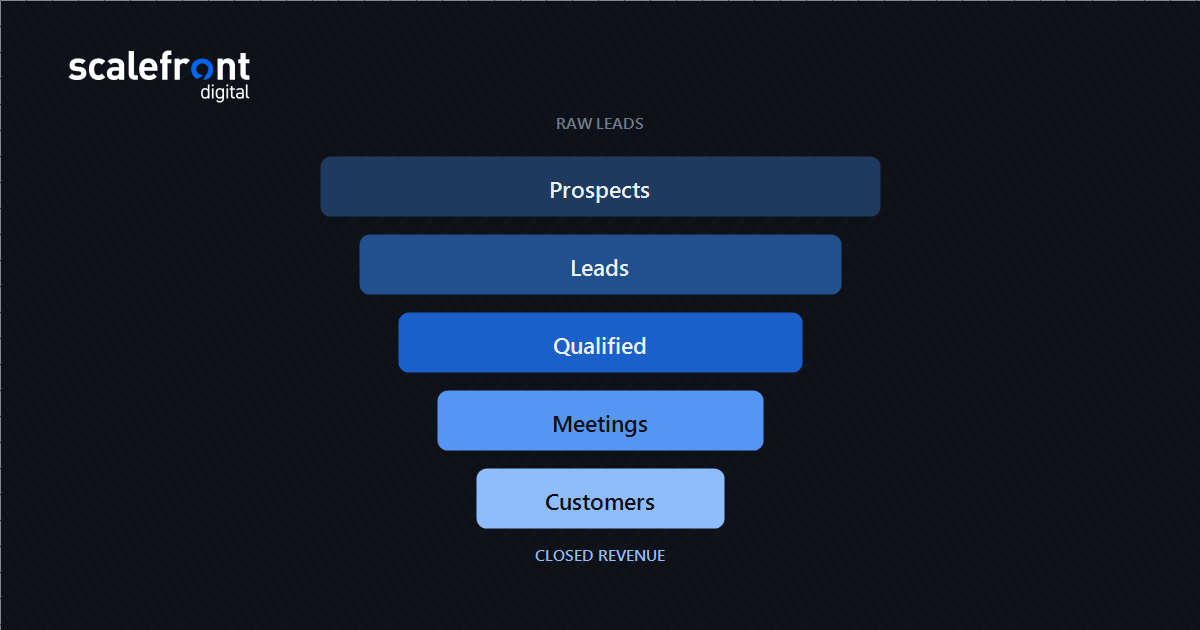
Everything above produces interest. Conversion turns it into revenue, and it’s governed by transitions rather than stages: Prospect → Lead → Qualified Lead → Meeting → Opportunity → Customer. Each arrow is a place people drop out, and each is fixable independently.
The leaks are usually structural. A campaign promises one thing and the landing page talks about something else, so the visitor arrives, fails to recognize the offer and leaves. Forms ask for information sales never uses, adding friction for no return. CTAs propose a commitment too large for the stage — “book a demo” to someone who has read one page. First meetings end without a defined next step, and multi-stakeholder decisions almost never resolve in a single conversation.
The discipline that fixes this is unremarkable: measure each transition separately, find the steepest drop relative to the others, change one variable there, and check it again. Improvements at this end of the funnel also compound faster than improvements at the top, because they apply to traffic and leads you’ve already paid to acquire — the practical argument for treating conversion optimization as part of lead generation rather than a separate website project.
Measure Pipeline, Not Just Lead Volume

Lead volume tells you how much activity happened. It says nothing about whether that activity was worth funding, which is how a program reports growth for two quarters while revenue flatlines.
A more honest set tracks the journey: qualified leads rather than raw leads; lead-to-meeting, meeting-to-opportunity and opportunity-to-customer conversion; cost per qualified lead and cost per opportunity rather than cost per lead; pipeline generated; revenue closed; response rate by channel and segment; and sales cycle length, which quietly determines how much pipeline you need to carry at any moment.
Read together, these diagnose rather than report. Strong response rates with weak meeting conversion point at targeting or messaging mismatch. Healthy meeting volume with poor opportunity conversion points at qualification. Good opportunity conversion with long cycles points at the sales process or the stakeholder map. Lead volume can’t distinguish between any of them, which is why lead generation ROI has to be calculated against pipeline and closed revenue to mean anything at all.
Common B2B Lead Generation Mistakes
The recurring ones, briefly:
- Targeting everyone plausible instead of the accounts you serve better than anyone else.
- Running on unverified data, then blaming the channel when replies dry up.
- Messaging that describes the company rather than the buyer’s problem.
- Depending on one channel, which works until a deliverability or algorithm change removes it.
- Skipping qualification because a full calendar looks like progress.
- Stopping follow-up early, usually just before most replies arrive.
- Losing context in the handoff, so the buyer restarts the conversation with a stranger.
- Reporting leads instead of pipeline, which hides the problem for a quarter or two.
- Treating launch as the finish line rather than a starting position.
Cheap to fix, expensive to ignore — an unusual combination, and the reason to audit these before adding spend.
A Practical B2B Lead Generation Framework
- Define the ICP — firmographics, pain, triggers, and the roles in the decision.
- Identify buying signals — the observable changes that show an account is in motion.
- Build and enrich target accounts — verified contacts, mapped stakeholders, real context.
- Select channels — matched to how your buyers evaluate and decide.
- Create relevant messaging — problem-led, specific, with a small next step.
- Launch outreach — sequenced across channels, consistent, with defined limits.
- Qualify responses — against criteria sales and marketing both agreed to.
- Follow up through CRM — routed, owned, tracked, context intact.
- Measure pipeline — conversion by stage, cost per opportunity, revenue.
- Optimize and scale — fix the weakest transition first, then add volume to what works.
The order matters. Scaling before step nine is how companies spend more money to generate the same problem faster.
How Scalefront Digital Approaches B2B Lead Generation
Scalefront Digital structures its services around that sequence rather than as standalone deliverables.
Intent Lead Research identifies which accounts are showing movement. Lead List Building & Enrichment turns those accounts into verified, contextualized records. Email Automation, LinkedIn Outreach and SMS Campaigns carry the message through the channels that suit the audience. CRM & Pipeline Automation ensures replies are routed, owned and followed up. Conversion Optimization works on the transitions between interest and closed revenue. A Managed Sales Process ties the pieces into a documented motion — strategy, playbook, campaigns, reply handling and reporting — for teams that would rather run one system than assemble six.
The connective logic is that each stage hands something usable to the next. That’s also where most in-house programs break: not because a single tactic is wrong, but because nothing joins them.
Final Thoughts
A B2B lead generation strategy converts when its parts stop operating independently. Targeting decides who hears from you and intent decides when. Data and messaging decide whether the message arrives and gets read. Qualification decides what reaches sales, CRM follow-up decides whether it survives the handoff, and conversion optimization decides how much becomes revenue. Measurement tells you which link to fix next.
Improve one of these alone and you’ll see a temporary lift. Connect them and the program becomes predictable — the only state in which lead generation can be scaled without multiplying the waste.
If you want a look at where your current pipeline is leaking, Scalefront Digital offers a free strategy call: a straightforward conversation about your targeting, outreach and conversion process, and what’s realistically worth changing first.
Frequently Asked Questions
What is a B2B lead generation strategy?
The documented system a company uses to identify target accounts, reach the right decision-makers, qualify interest and convert it into pipeline. It spans targeting, intent, data, messaging, channels, outreach, qualification, CRM follow-up, conversion and measurement — not a single campaign or channel.
What makes a B2B lead generation strategy effective?
Connection between the parts. Precise targeting, accurate data, problem-led messaging, consistent multichannel outreach, agreed qualification criteria and disciplined follow-up each depend on the others. Effectiveness shows up in qualified pipeline and revenue, not lead count.
How do you generate high-quality B2B leads?
Narrow the target market to accounts you can genuinely serve, prioritize those showing buying signals, verify and enrich the contact data, write messaging that addresses a specific problem, and qualify responses before they enter the pipeline. Quality depends far more on who you contact than how many.
What role does an ICP play in B2B lead generation?
The ICP defines which accounts are worth pursuing — industry, size, geography, business model, pain points, buying triggers and the roles involved in the decision. It sets the standard for list building, focuses messaging, and provides the first criterion in qualification.
Which channels can support B2B lead generation?
Cold email, LinkedIn, organic search, referrals, paid acquisition, partnerships and, in specific cases, SMS. The right mix depends on where your buyers pay attention, how long the sales cycle runs, how many stakeholders are involved and what the deal size justifies per touch.
How can businesses improve lead conversion?
Measure each transition — lead to qualified lead, meeting, opportunity, customer — separately, then fix the steepest drop. Common causes are message-to-page mismatch, high-friction forms, CTAs that ask too much too early, weak qualification, context lost in the sales handoff, and follow-up that stops too soon.