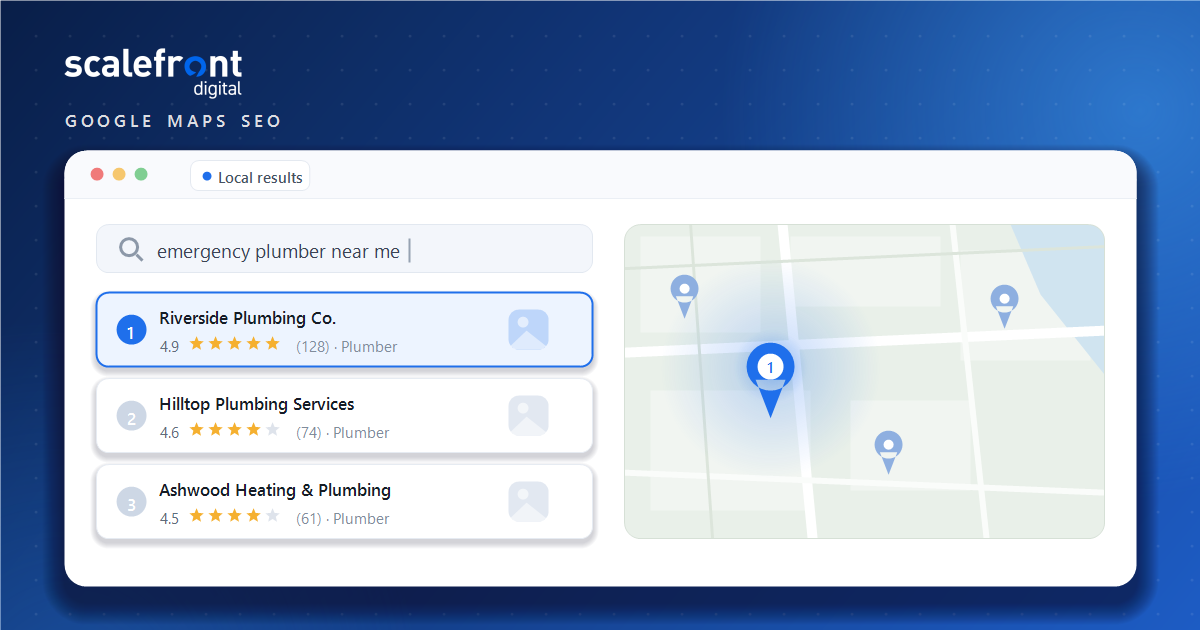
Someone two miles away just searched for what you sell. Three businesses appeared on the map. If you were not one of them, that search was worth nothing to you, however good your website is. Fixing that is the whole job of Google Maps SEO, and it is where our SEO services begin for most small businesses.
Local search is one of the few areas where a smaller business can genuinely outrank a larger one. Google is not asking who is biggest. It is asking who is closest, most relevant and most credible for this particular search, and two of those three are things you control directly.
That is worth sitting with, because it is the opposite of how national SEO works. A local plumber has no realistic path to outranking a national chain on a general search. On a search made two streets away, the chain’s size counts for very little and the plumber’s profile, reviews and proximity count for almost everything. This guide covers how Google decides those rankings, what to fix on your Google Business Profile, how reviews and citations feed into it, and how local search is shifting now that a significant share of people ask an AI assistant instead of typing into Google.
What is local SEO?
Local SEO is the practice of improving how a business appears in searches tied to a location, including Google Maps, the local pack of three results, and organic results with local intent.
It differs from standard SEO in one structural way. National SEO competes on content and authority across an entire country. Local SEO competes inside a radius, where the competing set is small and proximity is itself a ranking factor. That makes the signals you can influence far more valuable than they are nationally.
How Google Maps SEO works
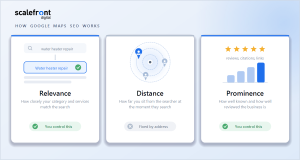
Google Maps SEO rests on three ranking factors that Google states publicly: relevance, distance and prominence.
Relevance is how closely your business matches the search. It comes from your business category, the services you list, and the wording on your profile and website. A plumber listed only as “plumber” will not surface reliably for “emergency water heater repair” against one who has listed that service explicitly.
Distance is how far you are from the searcher or from the place they named. You cannot change your address, but you can define your service area correctly and make sure Google knows precisely where you are.
Prominence is how well known and well regarded the business is. Reviews, citations, links and general web presence all feed it.
Most businesses that lose at local SEO have not lost on distance. They have lost relevance and prominence, because nobody has ever worked on either.
Local search is no longer only Google
This is the part most local SEO advice has not caught up with.
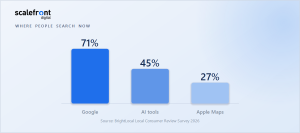
According to , use of ChatGPT and other generative AI tools for local business recommendations has grown to 45%, while Google’s share has fallen from 83% in 2025 to 71%. Apple Maps usage nearly doubled over the same period, from 14% to 27%.
Google is still dominant and still where most of the work pays off. But nearly half of consumers now ask an assistant for local recommendations at least some of the time, and those assistants draw on the same underlying signals your Google ranking depends on. Getting the fundamentals right serves both, and there is a section on the specifics further down.
How to optimize your Google Business Profile
Your Google Business Profile is the most important asset in local SEO, because it is what populates the map results. A website cannot rank in the local pack. Only a profile can.
Claim and verify the profile. An unverified listing cannot compete, and until you own it your business details remain editable by strangers.
Choose the primary category carefully. This is the strongest relevance signal available, and most businesses pick too broadly. A category of “contractor” competes against every trade in town. “Roofing contractor” competes against roofers. Add secondary categories for genuine services, but do not pad the list, because diluted categories weaken the primary one.
List your services individually. Each one is another route by which a search can reach you. A dental practice listing implants, whitening and emergency appointments separately can appear for all three. One listing only “dentist” competes for a single term.
Set accurate hours, including holidays. Google demotes profiles it suspects carry wrong information, and holiday hours are the ones businesses forget, which is exactly when a wasted trip turns into a one-star review.
Define your service area if you travel to customers rather than receive them. Getting this wrong makes you invisible in half the towns you actually serve, and the owner rarely notices because the profile looks correct from their own address.
Add real photographs, regularly. Exterior, interior, team, completed work. An active profile outperforms a dormant one, and stock imagery is worse than none, because customers recognize it and it signals a business with nothing real to show.
Answer the Q&A section yourself. You can ask and answer your own questions. If you leave it empty, a stranger will eventually answer on your behalf, and they may be wrong.
Use Posts for offers, updates and events. They expire after seven days, so a single post is worth little and a monthly habit is worth a lot.
NAP consistency and local citations
NAP means name, address and phone number, and consistency means all three appear identically everywhere online.
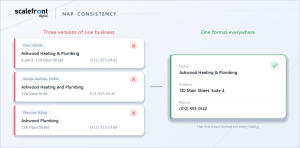
This sounds trivial and is not. If your address reads “Suite 4, 120 Main Street” on your site, “120 Main St #4” on one directory and “120 Main Street” on another, you have handed Google three slightly different businesses to reconcile. That uncertainty costs you prominence.
Fix it in this order:
- Decide the single correct format for name, address and phone number
- Make your website match exactly, footer and contact page included
- Update the Google Business Profile to match
- Work through major directories, then industry-specific ones
- Find and remove old or duplicate listings
Duplicates are worth hunting specifically. Two listings for one business split reviews and signals between them, and neither ranks as well as one would.
Why reviews decide more than rankings
Reviews influence local rankings and they decide whether anyone clicks once you rank. The second is often worth more, and the 2026 BrightLocal data makes the case plainly.
97% of consumers read reviews for local businesses. Ranking first without them puts you in front of people who will then choose someone else.
68% will only use a business rated four stars or above, and 31% will only use one rated 4.5 or above. There is a hard floor beneath which position stops mattering.
47% will not use a business with fewer than 20 reviews. Volume is a threshold, not a nice-to-have.
74% look for reviews written in the last three months. Forty reviews from three years ago carries less weight than twelve from this quarter, and recency is the metric most businesses ignore.
80% say they are more likely to use a business that responds to all reviews, and 19% expect a same-day response.
The practical conclusion is to ask systematically rather than occasionally. 78% of consumers were asked for a review in the past year and 28% say they will always write one if asked, so the ask itself is most of the work. The best moment is immediately after the job is done and the customer is pleased.
Do not offer incentives and do not filter who you ask. Both breach Google’s policies and both are detectable.
On-page SEO for local search
Your website supplies the relevance signals behind the profile, and it is where organic local results come from, so the two are not alternatives.
Build one page per service and per location. A single page attempting to rank for six towns will rank for none of them, because it cannot be genuinely relevant to any one. Separate pages work, but only if the content is actually different. Six near-identical pages with the town name swapped are worse than one honest page.
Put the location where it counts: page title, H1, URL, and naturally through the body. That is a different thing from stuffing town names into a footer list, a pattern that stopped working years ago and looks exactly like what it is.
Repeat your name, address and phone number in the footer of every page, in the agreed format. This is the source Google cross-checks your profile against, so a mismatch here undoes the citation work everywhere else.
Add LocalBusiness schema markup so hours, address, phone and reviews are machine-readable rather than inferred. It costs one block of code, and it is what AI assistants read first when deciding whether your business is a confident answer.
Answer local questions in the content. Parking, how quickly you can reach a given area, which neighborhoods you cover, what happens on a first visit. A national competitor cannot write any of it.
A slow or awkward mobile experience undermines all of this, because most local searches happen on a phone, often while the person is already moving. On mobile data, the gap between two seconds and six is the gap between a call and a competitor. Our website design and development work is usually where that gets fixed, through page speed, tap targets and forms built for a phone first. Test your own site the way a customer meets it, on a phone, on mobile data, away from the office Wi-Fi.
Local link building
Links drive prominence, but local link building is a different exercise from the national version. You are not chasing domain authority. You are establishing that a real business exists in a real place.
The links that count are ones a national competitor cannot get:
- Local chamber of commerce or business association
- Suppliers, partners and trade associations you genuinely work with
- Local news coverage of something you actually did
- Sponsorship of a local team, event or charity
- Community sites, local blogs and event listings
A handful of these outperforms a large number of generic directory links, and they carry no penalty risk.
How to appear in AI search results
AI assistants do not maintain a separate directory of local businesses. They draw on your Google Business Profile, your reviews across platforms, your citations and the content on your own site, which means the work is not separate from everything above. Three things carry more weight than they used to.
Structured data does the heaviest lifting, because it hands an assistant unambiguous facts instead of prose it has to interpret, and interpretation is where details get dropped or wrong.
Review presence across platforms matters more than a single strong profile. BrightLocal found the average consumer consults six different review sites, and an assistant aggregating sentiment looks across them rather than at Google alone. A business with sixty Google reviews and nothing elsewhere is less visible to that process than one with thirty spread across three sites.
Plain answers to plain questions on your own pages are what actually get quoted. Opening hours, service areas, how pricing works, what a first appointment involves. Direct sentences are quotable and marketing copy is not.
Claim your listings beyond Google while you are at it. Given the Apple Maps growth above, and Bing Places taking about an hour to set up, there is little reason not to.
How to measure local SEO
Track four things. Rankings alone mislead, because local position varies by the searcher’s exact location.
Google Business Profile insights show which searches surfaced your profile, split by direct and discovery. Discovery searches are the ones local SEO is winning.
Actions from the profile, meaning calls, direction requests, website clicks and messages, are the nearest thing to a conversion the profile offers.
Organic traffic to your location and service pages, separated from the rest of the site, shows whether the on-page work is landing.
Calls and inquiries, attributed to source wherever you can manage it, are what the other three are for.
Measure ranking from several points across your service area rather than from your own front door, because your rankings at your own address will always flatter you.
Traffic only pays if the page converts it, which is why local SEO and conversion optimization belong in the same project. Ranking third and converting well beats ranking first and losing the visitor.
Common local SEO mistakes
- An unclaimed or unverified Google Business Profile, which cannot compete at all
- Duplicate listings splitting reviews and signals
- Inconsistent name, address and phone number across the site and directories
- One page targeting multiple towns instead of one page each
- No systematic review process, leaving review flow to chance
- Ignoring negative reviews rather than replying
- A service area set incorrectly, or not at all
- Presence only on Google, missing Apple Maps and Bing
How long does local SEO take?
Local SEO usually shows movement faster than national SEO, often within 30 to 90 days, because the competing set is smaller and profile changes are read quickly.
Profile work surfaces first. Category corrections, service listings and photographs can shift visibility within weeks. Review velocity and citation cleanup build over months. Links and content take longest, as everywhere.
A business starting from an unclaimed profile in a moderate market will see change sooner than one in a dense city where every competitor already does this well.
Frequently asked questions
What is local SEO?
Local SEO is the practice of improving how a business appears in location-based searches, including Google Maps, the local pack and organic results with local intent. It focuses on the Google Business Profile, location relevance, reviews and citations rather than national authority.
What is Google Maps SEO?
Google Maps SEO is the work of ranking a business in the map results and the local pack, rather than in standard organic listings. It centers on the Google Business Profile, because only a profile can appear on the map, and Google ranks those profiles on relevance, distance and prominence.
How do I rank higher on Google Maps?
Claim and complete your Google Business Profile, choose an accurate primary category, list services individually, keep your contact details consistent everywhere, build a steady flow of recent reviews, and earn links from genuinely local sources. Google ranks local results on relevance, distance and prominence, and two of the three are within your control.
Is local SEO different from regular SEO?
Yes. Regular SEO competes nationally on content and authority. Local SEO competes within a radius, where distance is a ranking factor and the Google Business Profile, not the website, appears on the map. Local SEO usually produces results faster because fewer businesses compete for each search.
How many reviews do I need for local SEO?
There is no fixed threshold, but BrightLocal’s 2026 survey found 47% of consumers will not use a business with fewer than 20 reviews, and 74% look for reviews written in the last three months. Steady recent flow matters more than a large total collected years ago.
Do I need a Google Business Profile to rank locally?
For the map results, yes. A website cannot appear in the local pack. Only a verified profile can, which makes claiming it the first action for any local business.
Does local SEO help with AI search?
Yes. Assistants draw on the same signals Google uses, and with 45% of consumers now using AI tools for local recommendations, structured data, consistent information and presence across multiple review platforms all improve the chance of being recommended.
Can I do local SEO myself?
The profile work, yes. Claiming, categorizing, adding services and photographs, and asking for reviews are within reach of an owner with a few hours. Citation cleanup, location pages and local link building take longer and are where most businesses bring in help.